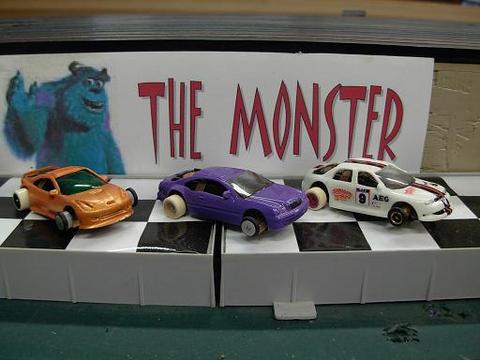
2009/10 FRAY RULES
Complete Car Regulations:
1) The complete car must weigh at or between 20.0 grams and 24.0 grams.
2) The complete car must freely pass through a standard 1.3125 (1 5/16) HO tech block.
Body Regulations:
1) Body: The body must be a copy of a 1:1 car and concept cars.
2) Bodies must be manufactured by either the process of casting or injection molding and be made of resin or plastic. No feather-light resin allowed.
3) Bodies must be originally manufactured with the intention of being mounted with the use of two (2) screws via two (2) body-mounting posts on a/an: Aurora Model Motoring (which includes: Vibrator, ThunderJet, Wild Ones, Tough Ones and Xlerators), Bachmann, Faller, Model Motoring ThunderPlus, Marx, Eldon or Tyco S series HO chassis.
4) Bodies with cast-in handling pans or exaggerated details - such as unrealistic or inappropriate hood scoops, oversized windows, side pipes, sloped sides, or snow plow noses - are not allowed.
5) No Indy style Formula 1 or Formula style open-wheel bodies will be allowed.
6) No ballast or fillers, other than color pigment, are allowed in the plastic or resin.
7) Maximum overall body width is 1.200. Accordingly, the body must pass through our 1.2 body-tech device.
The maximum thickness of the lower portion of the body, including items such as the front end, rear end, fender flares, and running boards must not exceed 0.125.
9) With the body mounted securely to the chassis and viewed from above, the body must cover the chassis except through windows and vents. Unrealistic overly large windows and vents are not allowed.
10) With the body mounted securely to the rolling chassis and when viewed from the side of the body, the upper edge of the top-plate, minus rails, cannot be above the top of the body as measured at the rear of the top-plate. (i.e.: The horizontal top of the gear plate (base) cannot protrude above the rear window opening).
11) Bodies must be fitted with all of the manufacturers original or exact-replica bumpers, heads, rollover bars, etc. in their stock locations.
12) Cracked or broken body-mounting posts may be repaired or replaced with the use of glue and/or a plastic sleeve around the original post or a plastic rod/tube in place of the broken post.
13) Other than the plastic post reinforcements, stated in Body Rule 12, no additional weight may be added to the body.
14) The body may be lowered and lightened by removing material through the process of grinding or scraping as long as Body Rule 9 is not violated. Bodies cannot be heated or reshaped from the original cast of the body.
15) Bodies that have a separate roof and windshield casting/molding, and have molded-in interiors (also known as Hardtops, e.g. Aurora's '65 Mustang), may completely remove the interior portion of the body.
16) Front and rear wheel wells may be opened up for tire wheel well clearance. This opening may be no larger than a 1/8-inch drill bit (.125") around the entire wheel well and tire.
17) Wheel wells must not be modified in such a way as to allow the use of any other wheelbase than that which was originally intended by the manufacturer of that body.
18) Any body-mounting screw may be used. Non-magnetic screws are recommended so that a loose screw will not be picked up by a passing car, thus causing damage to the car and/or the track.
19) Both front and rear screws must be used and must secure the body to the chassis at all times.
20) The front windshield must be plastic or resin, clear or painted, may be glued in place or molded in, and must fill the frame. Tape windshields are not allowed. Side and/or rear windows may be removed.
21) Bodies that violate Body Rules 4 and 9 by having illegal openings such as too large or unrealistic windows, missing engine covers, and open truck beds may be repaired by gluing a 0.025 minimum thickness plastic cover over the opening. The repair must be made so that its thickness can be checked using a micrometer having a diameter anvil.
ThunderJet Rolling Chassis Assembly Regulations:
1) Only original Aurora ThunderJet chassis assemblies with non-plated copper electrical components are allowed. Commutator brush springs may be bent to alter brush tension. Pickup shoe hanger plates may be bent.
2) The rolling chassis axle, armature, and drive pinion shaft holes may be opened up slightly for increased clearance.
2a) The Truck hole cannot be utilized in any way.
3) The rolling chassis assembly must not be fitted with bushings.
4) The chassis may be trimmed slightly (no more than .010) to allow for crown gear tooth clearance.
5) Only an original Aurora T-Jet pancake gray armature with two laminations, with its original commutator, and all of its original unmodified windings may be used. The armature may be balanced and trued.
6) Each armature pole is to be measured across two separate commutator segments. The AVERAGE of all three poles must be 16 ohms or greater. i.e.: Pole A measures @ 15.8 ohms, Pole B measures @ 16.2 ohms and Pole C measures @ 16.0 ohms This armature is LEGAL. All measurements are to be taken at the current available room (ambient) air temperature. The warming of either the commutator or the armature is not allowed before/during measuring. (The combined total ohm reading of all three armature poles must equal or exceed 48 ohms.)
7) Only Johnny Lightning and AutoWorld magnets may be used. The magnets may be sanded to fit the chassis. The distance between the magnets must be a minimum of .700"; no exaggerated sanding is allowed to close the armature gap. This will be teched using our custom-designed, specially fabricated Plug.
Magnet shims may not be used. No shims are allowed either under or on top of the magnets.
9) Any flat top and bottom carbon/copper motor brushes are allowed. Brushes may be scored with one score line or an X. No exaggerated deep cuts or crevices allowed; this will be checked for at tech.
10) Only stock T-Jet or commercially available stock replacement 14 tooth brass armature pinion gears are allowed.
11) Only stock T-Jet or commercially available stock replacement 24 tooth brass idler and driven gears are allowed.
12) Only stock T-Jet or commercially available stock replacement 9 tooth brass drive-pinion gears are allowed.
13) Only stock T-Jet or commercially available stock replacement 15 tooth crown gears are allowed. The crown gear must equal or exceed .300". The crown gear boss may be trimmed, spacer(s) may be added to adjust for proper gear mesh within the crown gear box. A new allowable alternative to this rule is: You can add a small delrin retainer to either side of the rear axle for the purpose of adjusting crown gear mesh with the 9T rear pinion. The diameter of the delrin retainer must not exceed 0.125" with a thickness not to exceed 0.070".
14) Only metal driven-gear shafts may be used. The driven-gear shaft must not exceed .065" in diameter.
15) Gear-tooth friction surfaces can only be de-burred by polishing, filing, or sanding.
16) Gears must not be chamfered, lightened, or relieved.
17) Only commercially available front wheel, tire, and axle assemblies may be used with two exceptions. The front and rear axle diameter must not exceed .065" and the front tire diameter must equal or exceed .300". Front axle washers (small spacers) are allowed. All spacers/washers must be located outside the chassis or chassis frame rail, With the exception to the above rolling chassis rule #13. Maximum lateral movement in the front wheel assembly is 0.031 (1/32). Note: Currently the only approved off-set weight front ends that are legal for the 2009 Fray are: Zoomin Motorsports #FE01 and RTHO #RT230.
18) Rear wheels may not be made of Brass or solid Delrin. No axle weights, wheel weights or hub caps allowed on rear axle or inside the wheels. Note: A small delrin retainer will be allowed on the drivers side rear axle for the purpose of adjusting crown gear mesh with the 9T rear pinion. The diameter of the retainer must not exceed 0.125" with a thickness not to exceed 0.070" (See Rule #13).
19) Any stock or stock replacement pickup shoe may be used. These shoes must have a factory formed step and the step must be unaltered except to allow flat pickup shoe contact with the track rail. American Line #313, BSRT #504, Slottech #1440, Wizzard #E-82 and stock Aurora ThunderJet shoes are allowed. Ski shoes are not allowed.
20) The "step" in the pick-up shoe must remain intact and be unaltered, except that only the first bend in the step, (Bend #2), may be changed slightly so that proper "pick-up shoe" to "rail" contact can be achieved. No attempts to "flatten" the "step" are allowed. The area between (Bend #1) and (Bend #2) may be "flattened" to achieve better contact with the "rails"; however, (Bend #1) must remain as stock. The front vertical slotted portion of the pick-up shoe may be bent to limit shoe travel. The rear hook portion of the pick-up shoe may be bent to limit shoe travel and adjust shoe tension. The chassis' copper pickup retainer may be bent slightly to improve electrical contact.
21) Pickup shoe springs may be cut, stretched, shimmed, or compressed.
22) Any amount of the vertical gear-plate rails above the upper horizontal plane may be removed. No amount of material may be removed from the gear-plate at or below the upper horizontal plane. The serial/patent numbers and letters must also remain intact.
23) Commercially available guide pins must be plastic and must be of a design essentially similar to the original Aurora black plastic front guide pins. They may be cut, trimmed, or bent. Countersinking of the guide pin screw hole is permitted.
24) Glue may be used on a rolling chassis assembly only for the purposes of attaching gears to shafts, guide pins to chassis, and front wheel axle retainers to the end of front axle. Solder may be used to attach metal gears to their metal shafts.